Engagement in Timeline
The Dynamics 365 Timeline on a contact, lead, or account is where your team tracks the history of every interaction with that person or company.
The Spotler Connector extends that timeline with Spotler engagement data — so instead of only seeing calls, meetings, and notes, your team also sees which emails were sent, whether they were opened or clicked, when an automation started, and when tags or scores changed in Spotler.
Everything stays in one place. No switching between systems to understand where a contact stands.
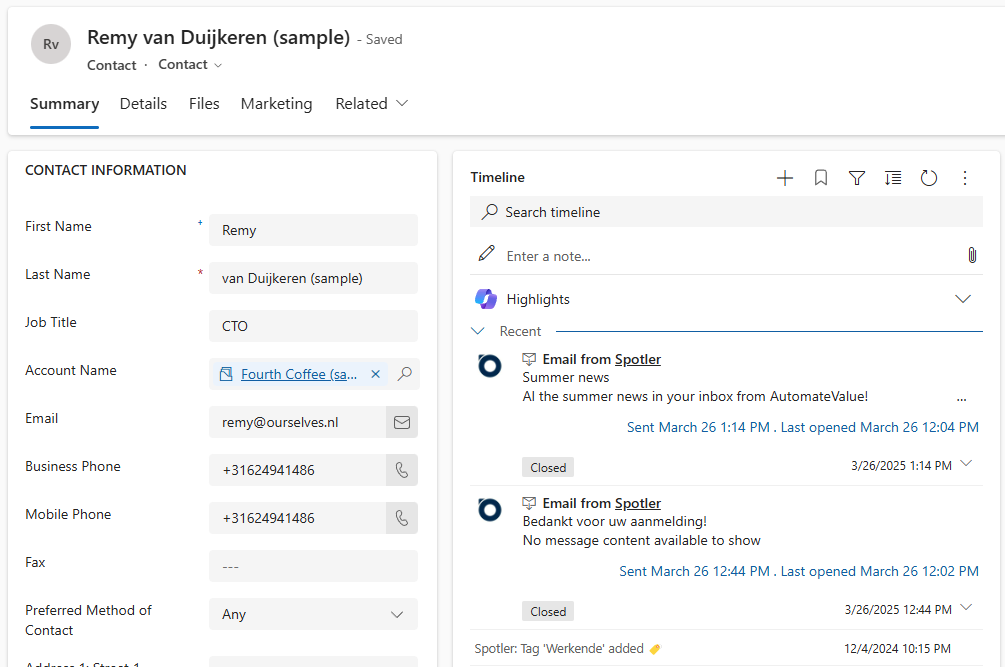
- Email activities
- Email Engagement (Dynamics 365 Sales)
- Automations, tags, and scores
- Choosing what appears on the timeline
Email activities
When Spotler sends a email to a contact, an email activity appears on that contact's timeline in Dynamics 365.
This activity is a living record — it updates automatically as the contact opens, clicks, or bounces, so the timeline always reflects the current state of engagement for that mailing.
💡 This is an opt-in feature. Email activities on the timeline require the Marketing Interactions feature to be enabled on your organization.
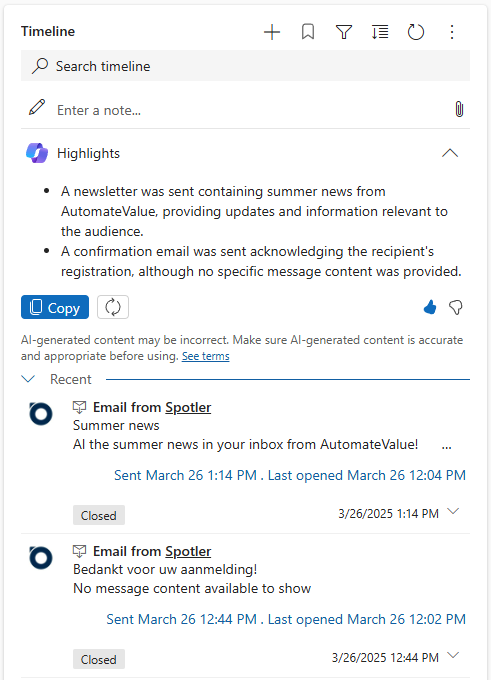
When the email activity is a Mailing in Spotler, it will show the full content of the email that is sent. Content is not available for emails sent by Automations or Campaigns.
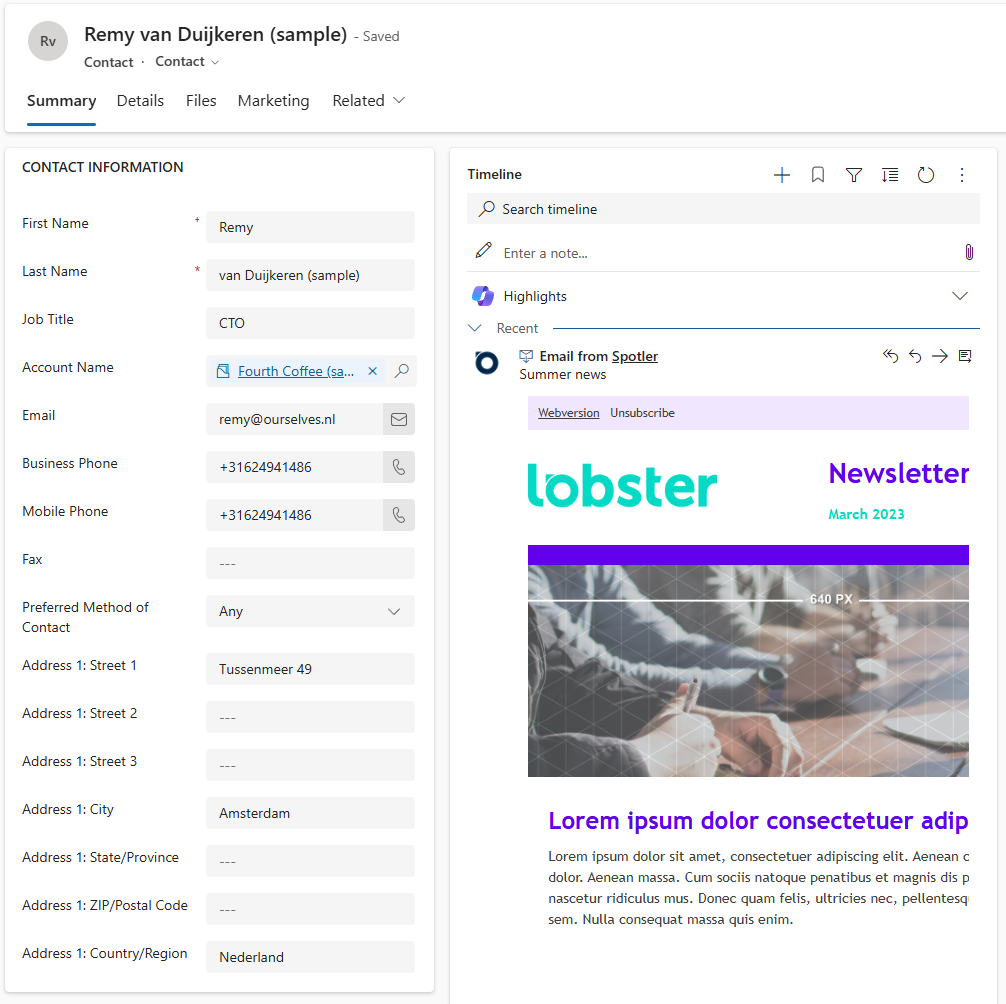
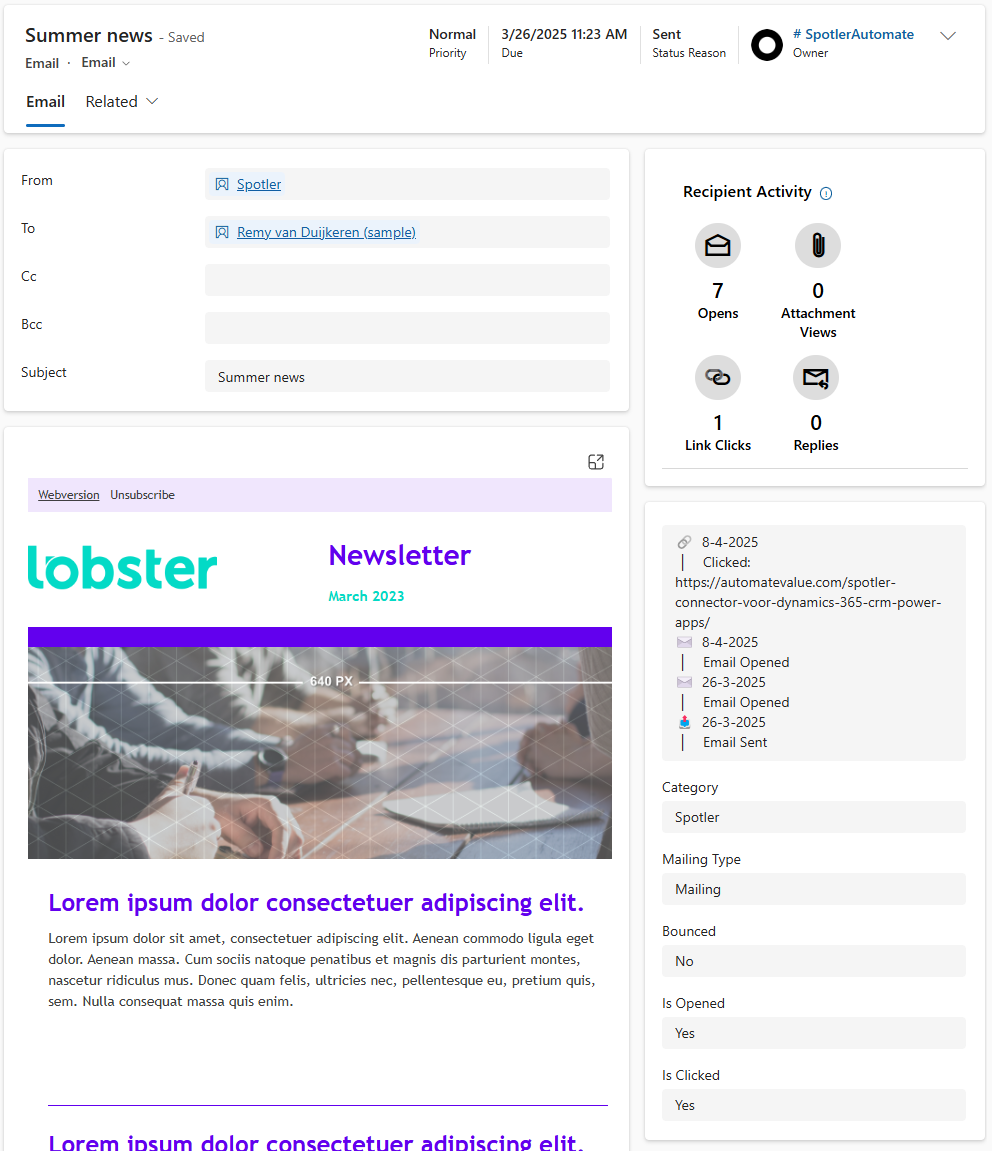
By opening the email activity you see the engagement on the email that was sent. The Category is always Spotler and the Mailing Type tells if it was send by a Mailing, Automation or Campaign. It also show cleary it the email was Opened, Clicked or Bounced.
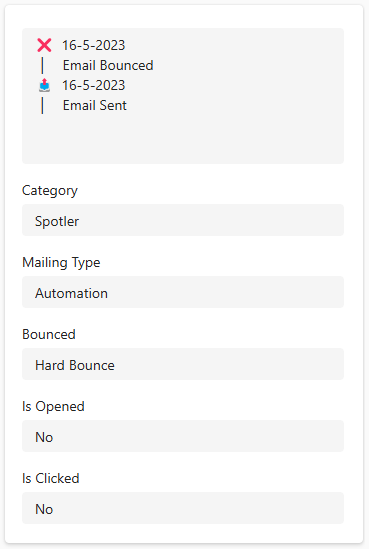
The activity also shows a chronological history of how the contact interacted with the email:
❌  16-3-2024
 │    Email Bounced
🔗  15-3-2024
 │    Clicked: https://example.com/offer
✉️  15-3-2024
 │    Email Opened
📤  14-3-2024
 │    Email Sent
Email Engagement (Dynamics 365 Sales)
If you have Dynamics 365 Sales module, enable Email Engagement for the best experience.
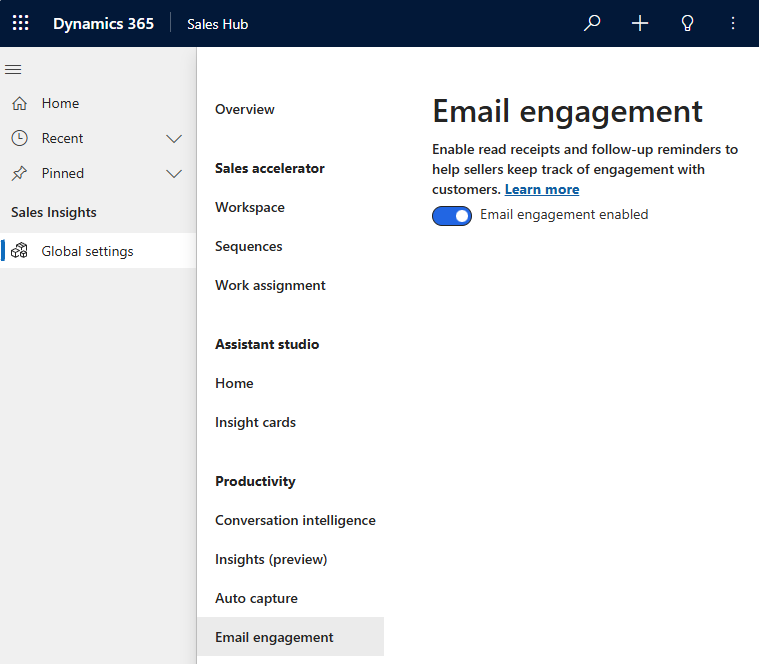
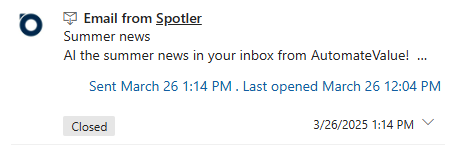
When enabled, the timeline card shows Sent and Last Opened timestamps without needing to open the activity.
This gives your sales team an at-a-glance view of who is engaging with mailings, directly from the contact or account timeline.
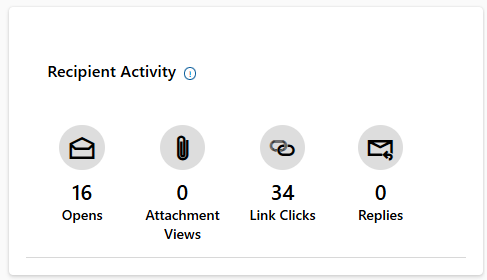
Opening the email activity shows now an additional Recipient Activity section.
💡 Email Engagement is a Dynamics 365 Sales feature. It is not available in Power Apps or other Dynamics 365 apps.
Automations, tags, and scores
Beyond email, the connector also posts short notes to the timeline when a Spotler action is triggered from Dynamics 365.
For example, when a Power Automate flow or a Dynamics 365 workflow starts a Spotler automation, adds a tag, or updates a score on a contact, a confirmation note appears on that contact's timeline:
| Event | What appears on the timeline |
|---|---|
| An automation started | Spotler: Automation 'Welcome sequence' started |
| A tag was added | Spotler: Tag 'prospect' added 🏷️ |
| A tag was removed | Spotler: Tag 'prospect' removed 🏷️ |
| A score was set | Spotler: Score 'Lead score' = 42 📈 |
| A score increased | Spotler: Score 'Lead score' +10 📈 |
| A score decreased | Spotler: Score 'Lead score' −5 📈 |
| A score was reset | Spotler: Score 'Lead score' reset 📈 |
⚠️ These notes only appear for actions that were initiated from Dynamics 365. Automations that start inside Spotler itself, or tags and scores changed directly in Spotler, do not generate a timeline note.
Choosing what appears on the timeline
AutomateValue can control which types of Spotler engagement show up on the timeline using the Timeline Interactions setting. The default is to show everything.
| Setting | What it controls |
|---|---|
| Mailing | Email activities for regular bulk campaigns |
| Campaign | Email activities for transactional emails |
| Automation | Email activities and automation-started notes |
| Tag | Tag added and tag removed notes |
| Score | Score change notes |
Turning off a type removes it from the timeline going forward — existing notes and activities are not affected.
⚠️ This setting is separate from the Interactions setting that controls Marketing Interactions feature. You can show automation events on the timeline without syncing them as individual Marketing Interaction records, or vice versa.